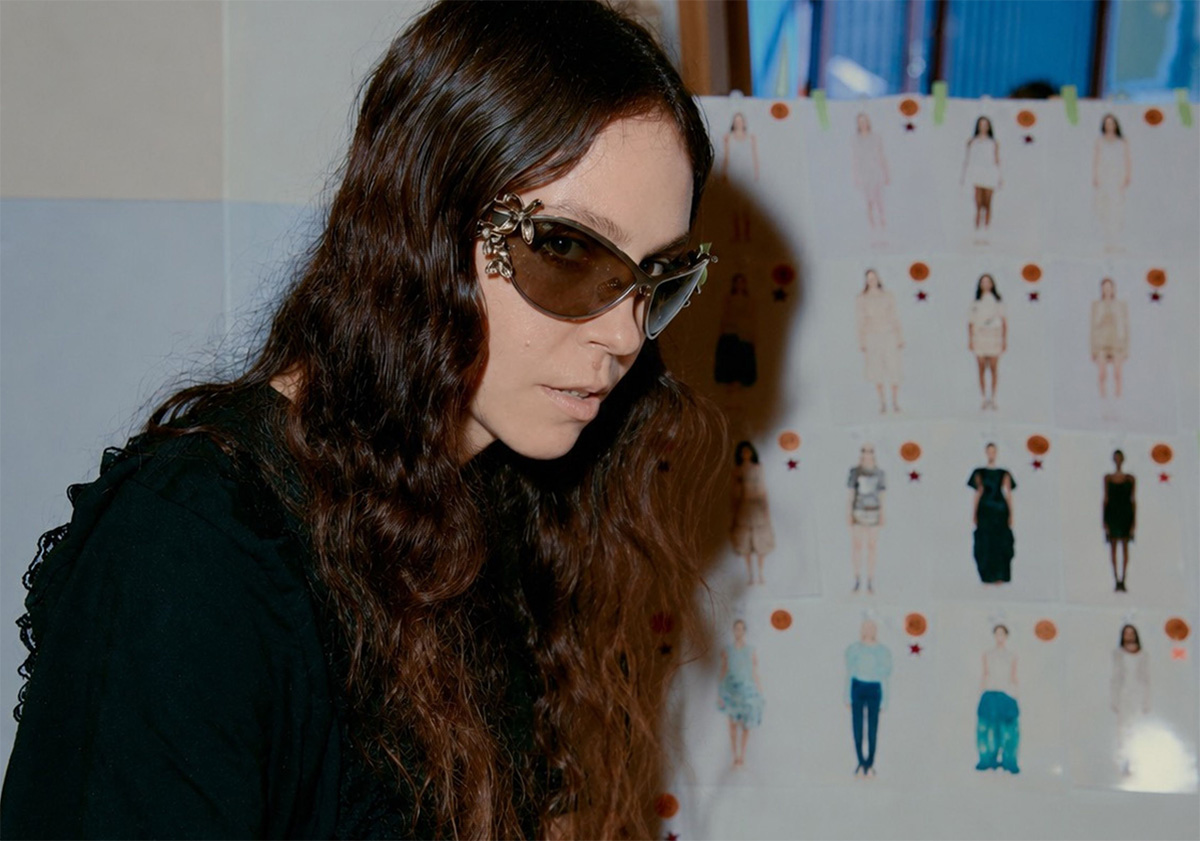
Autumn Winter 2022

Backstage in Tokyo

Photography by Noam Levinger & Words by Arieh Rosen

Comme des Garçons Women’s AW2022
Photography by Noam Levinger, Tokyo

Rei Kawakubo, founder of Comme des Garçons, has not left Japan since the outbreak of Covid. Known as a designer who controls each and every detail of her kingdom, the last two years have forced her to live in A confined reality, limited to the boundaries of her home and office located in central Tokyo. The shows she used to present in Paris since the early 1980s have been moved to a modest space located on the top floor of the company’s office building. Kawakubo’s extraordinary designs express how she perceives the world, at times responsive to current affairs and at others appearing as a prophet, and occasionally completely disconnected in a world of her own. Kawakubo started out by studying philosophy rather than fashion, which seems to have become the basis of what she presents under the spotlight of the runway; a Japanese philosopher whose main language is the visual one.

BLACK ROSE is the name of the collection Kawakubo presents for Autumn Winter 2022. Unsurprisingly, an unequivocal reference is difficult to infer given the delicate state of the world today, while at the same time, reality is present in each and every element of the show. One may wonder whether we as viewers suffer from the inability to disconnect from a powerful reality, even at the entrance of the isolated space where the show takes place? Or maybe it is Kawakubo, who must have started working on the collection long before the Russian invasion, managing to once again produce fashion so independent from the rest of the industry, alienated from mainstream conceptions of clothing yet able to magically predict and touch reality in a profound, focused and painful way.

In previous interviews, Kawakubo notes that her creative process of a collection often begins with one word, from which she embarks on a journey, sometimes lacking clear direction or logic. There is no black rose in nature, only dark shades of other colours. The rose can symbolise revolution, and the black rose in particular can symbolise anarchist movements. The black that unfolds and disintegrates in the collection evokes these references and other emotions, which is amplified by the spectacle itself commencing in darkness. The space is suddenly flooded with light, concentrated between two beams facing each other on either ends of the space, dazzling the models walking below. Contrary to the sterile, pristine notion of the runway, the clothing and shoes leave dust marks and dirt tracks, transforming Kawakubo’s floor into an image of land that has seen vast amounts of human movement.

Photography by Noam Levinger

The show is accompanied by an Irish flute playing an Irish political song Roisin Dubh, which literally translates into ‘Black Rose’. The music establishes an immediate connection to the previous men’s collection, ‘NOMAD,’ presented in the same space a few weeks ago.  Her perspective on the nomad was then, prior to the war, somewhat naive and even romantic. With more than two million Ukrainians forced to flee, the present tone has sharply changed. The Irish flute takes us on a lonely journey to a distant place. This time around, the pace is extremely slow, the looks are sharp, and the perspective of the nomad has sobered. The first model appears in a dress that seems to have been constructed from an old mattress or a military blanket. Kawakubo tears, disassembles and tailors these fragments into a beautiful new form. The female body takes on a new shape, a task Kawakubo regularly executes. The new forms are designed to contain as many layers, components and shapes as possible, reflecting and befitting the needs of refugees, soldiers and nomads – those who set out with all of their worldly possessions. The clothing, in its layers, create an ability to contain and possess more than the body that wears it, derived from fabrics that appear to be organically utilised as well as violently reshaped in order to take on radical forms.

Kawakubo often collaborates with various artists to design hats, wigs and other head pieces, which are integral components of her stories and looks. For BLACK ROSE, Kawakubo works with long-time collaborator Gary Card to create protective helmets in their various evolutionary design stages made of rigid materials carried on the models’ heads.  Some of the helmets seem to have melted out of knitted wool or other organic materials, presented in differing levels of construction as if decomposing and digesting themselves. Other pieces are covered in soft, absorbent materials like wool or felt, conveying a sense of negligence brought about by urgency, reminiscent of the helmets being worn on the current battlefields. The pieces seem to contain a whole lifetime, carried on the head. It is unclear which comes first, inspiration or reality, where the creation is born and whether it hears the terrible sounds of war.

Photography by Noam Levinger

Photography by Noam Levinger

Photography by Noam Levinger

Photography by Noam Levinger

NOIR KEI NINOMIYA


“FLUORESCENT

Creating a new world by mixing different colors to black, which is the identity of noir kei ninomiya.

Neon pink, green and yellow

Organic motifs using phosphorescent materials”

JUNYA WATANABE

“I created this collection using elements of motorcycle jackets, bomber jackets and wool check jackets.
This collection was inspired by Plight (The Spiralling of Winter Ghosts), the collaborative album created by DAVID SYLVIAN and HOLGER CZUKAY in the 1980s.

In particular, I found the subtitle The Spiralling of Winter Ghosts poetic and beautiful, and it became the inspiration for the video.

I was also impressed to see that the content of the article about this track, written by David Sylvian, was exactly the same as our feeling about creation.”

READ MORE…

Cover of Article "A Studio Visit with Hillary Taymour"

A Studio Visit with Hillary Taymour

For her first show outside New York, Hillary Taymour brought Collina Strada to Copenhagen for Spring Summer 2027, a season that also marked Copenhagen Fashion Week’s 20th anniversary. Collina Strada was the first brand invited to take part in its new International Guest Slot, supported by The Climate Pledge.


Read more

Cover of Article "A Studio Visit with Paolina Russo and Lucile Guilmard"

A Studio Visit with Paolina Russo and Lucile Guilmard

There is something about Paolina Russo that makes you want to be part of the gang. Canadian-born, half Filipina and half Italian, Russo grew up in Markham, Ontario, while her French co-founder Lucile Guilmard was raised in Fouras, a small seaside town on France’s Atlantic coast. Their London-based label draws on the things they grew up with far away from fashion capitals: arts and crafts, local sports, video games, music and the particular kind of imagination that comes from having to make your own fun.

Read more

Cover of Article "A Studio Visit with Jenia Kim"

A Studio Visit with Jenia Kim

On a leafy street in Yunusabad, just north of central Tashkent, behind a wrought-iron gate and a garden planted with roses, irises and young fruit trees, stands a pale yellow villa that once belonged to a prosecutor in the municipal justice system. Today it houses the studio of designer Jenia Kim, whose eponymous label — founded in 2014, while she was living in Moscow — has become one of the defining voices in contemporary Central Asian fashion. While many designers from the region have built careers by leaving, Jenia has spent the last four years doing the opposite: building a company, a studio and, increasingly, a creative community in the city where she was born.

Read more

See all Articles

A News in your inbox