Jemma Pinueva in conversation with Hillary Taymour
A Studio Visit with Hillary Taymour
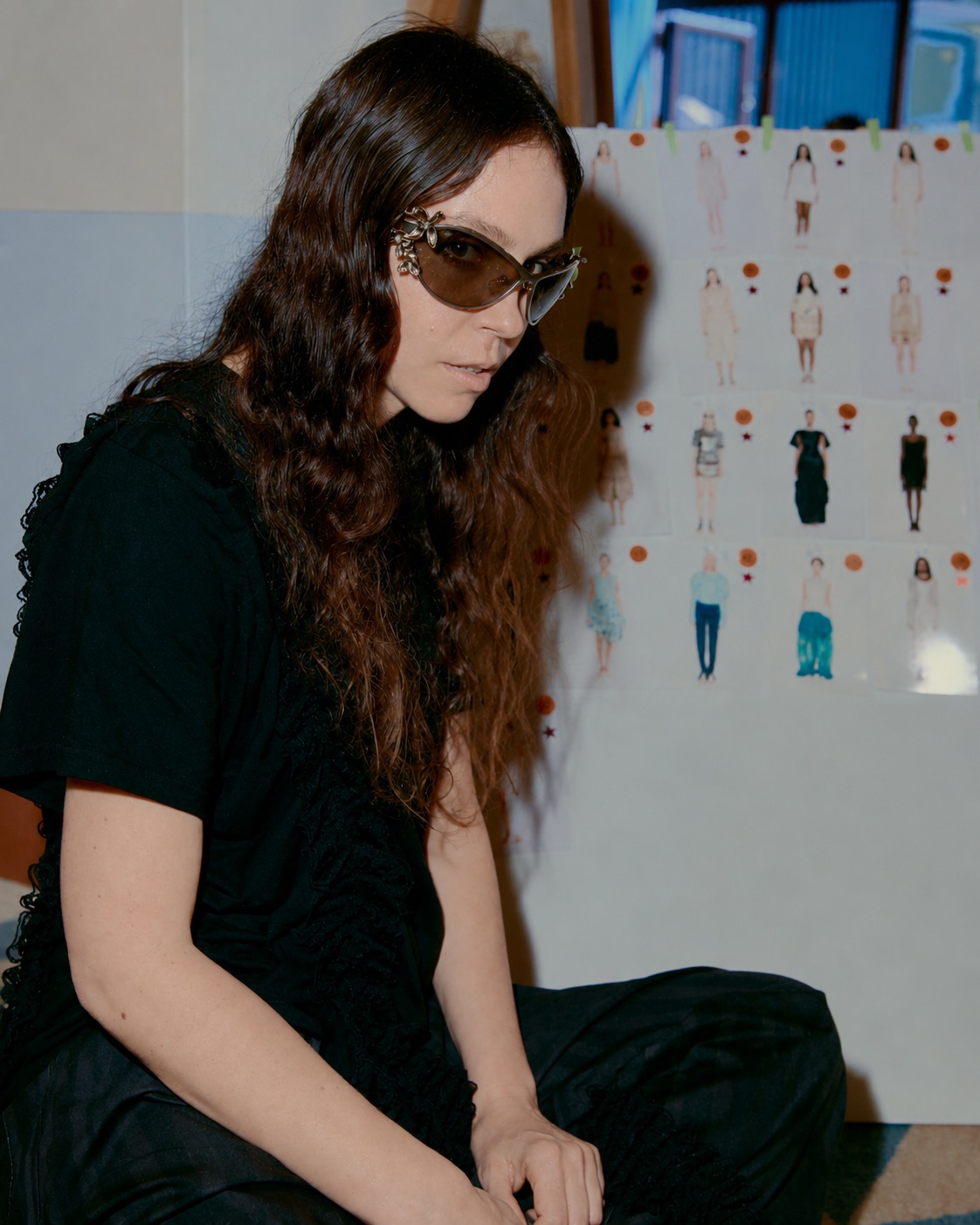
For her first show outside New York, Hillary Taymour brought Collina Strada to Copenhagen for Spring Summer 2027, a season that also marked Copenhagen Fashion Week’s 20th anniversary. Collina Strada was the first brand invited to take part in its new International Guest Slot, supported by The Climate Pledge.
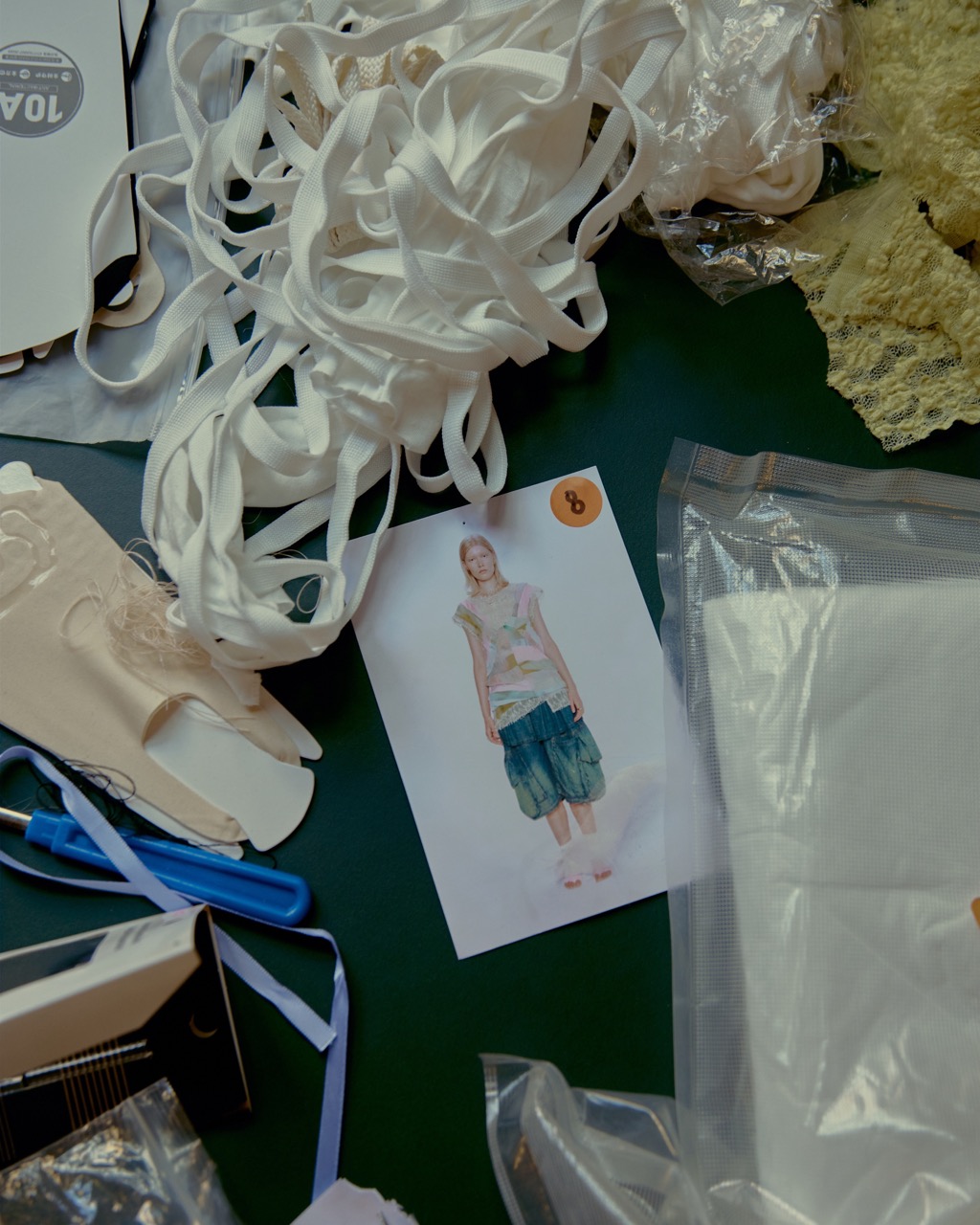
For the occasion, Taymour created Delirium in Bloom, a one-off collection made from deadstock, test swatches and fabric experiments accumulated over the years in the brand’s New York studio. Free from the usual constraints of production, she returned to things that had been sitting around the studio, waiting for their moment.
When I arrived at 25hours Hotel Indre By, Collina Strada’s temporary base for the week, Taymour was sitting on the floor working on her laptop. She looked up, tapped the floor beside her and said, ‘Sit here.’ The room had a sort of feeling of the cool kids sitting at the back of a classroom about it. Music was blasting; people sitting on the floor, clothes and bags strewn everywhere, with glitter covering almost every surface. It felt a little like a house party with all the lights left on. Across the room, Eugene Souleiman was testing hair on model Taylor Larzo, weaving tinsel, feathers and flowers through it. Friends and members of the team came and went, stopping Taymour with questions as we spoke. Our interview happened somewhere in the middle of it all.
The next evening, Delirium in Bloom unfolded in the park outside Copenhagen’s Opera House, overlooking the harbour. Models walked to live strings in sheer, intricately manipulated layers of chiffon and tulle, ribbons and flowers. The hair I had watched Souleiman test the day before now appeared across the cast. The strange little world taking shape on the hotel-room floor had made its way outside.
‘There was a certain moment in my life where I was trying to please others with the brand, and now I just try to make myself happy.’
Hillary Taymour


Jemma Pinueva: You’ve shown in New York for years. Does being in Copenhagen make you approach a show differently?
Hillary Taymour: I just give less fucks. I can kind of just do whatever I want. I’m not having to worry about, like, ‘My DNA won’t let me do that.’ It’s a little bit more free. We’re going to show things that I wouldn’t be able to produce normally. What’s weird about doing shows — and what’s my problem with doing shows — is we sell probably 98 per cent of what is on the runway. And it has to be at a Collina Strada price point, so it limits me massively in what I can and can’t design. So this is kind of like: no restricted cost, not worrying about that, just making the thing.
JP: The collection started with things that were already sitting around your studio?
HT: I started from a lot of the remnants. I’ve had years of fabric-manipulation test swatches — just little piles of shit in my studio. So, we would test: ‘Oh, we like this flower. No, we actually don’t like this flower. But we still keep that flower.’ We’ve been keeping, piling, adding and creating based off all these techniques that we’ve never been able to showcase before and reusing things that have in the studio that never had their moment. Now this is the moment.
JP: This is your first time working with Eugene Souleiman. How has that been?
HT: It’s really fun. I love him. I’m so excited because he’s just magic. And also chill and laid-back and just happy to do the job and get excited. We’re going to be doing the hair in this really chaotic way.
JP: Your shows always feel like performances. Why is that important to you?
HT: Because that’s how they always were in the 1990s. And then we all got too fucking serious and everyone started getting in, and then it became such a job. Before, it was entertainment. It was a spectacle. You know, like Gaultier. It was the show.
JP: Would you have liked working in fashion then?
HT: Yeah. I would’ve been really good at it.
JP: Do you think people in New York take fashion too seriously? I always thought that was more of a Paris problem.
HT: Everyone does. But I don’t. I want it to be fun. I think the thing I could say that has made me feel the most successful is that when people come to my show and they actually have no fucking clue what’s going to happen. I’ve trained them to think that way, which is why it’s good. People come in and they’re like, ‘Oh, we kind of understand now what’s going to happen.’ But when you sit down at a Collina Strada show, you never know what music is going to turn on, you don’t know what the models are going to look like. It’s always different.
JP: Do you have a favourite Collina Strada show?
HT: They’re all not good enough.
JP: Are you a perfectionist, then?
HT: What keeps me going is the fact that I hate them, and then I want them to be better. If I liked them, I’d probably quit. I just want to get better every time. I want to do better. I want to be the best that I can be. That takes time.
JP: Do you ever actually get everything you imagined out of a show?
HT: One time I talked to Marc Jacobs at a party. He was like, ‘Oh, I loved your last show.’ And then he goes, ‘Do you ever feel like you don’t get everything out of the shows that you want?’ And I’m like, ‘Yeah, dude. I get, like, 10 per cent of what I want from a show.’ He definitely got a higher percentage of what he wanted, but at the end of the day, that’s what keeps us going and striving for more. That’s what gives you better questions, better new ideas and more interesting things. Or else it’d be fucking boring. Also, if I loved every show, why would I do another one? Like, this is perfect. Done. Career over.
JP: Do you enjoy the process, though?
HT: Yeah, it’s just fun. But people were just yelling at me because of the hem of the pant. They were like, ‘You told me to do it like this, but now you want to do it like this, blah blah blah.’ And I’m like, ‘Yeah.’ It’s that tension is what creates good art. We have to have tension and have all these feelings.
JP: Is managing all those different people and opinions part of it?
HT: It’s also managing everyone’s ego. Makeup, hair, even a photographer, you know — everything. You’re all working as a team. They’re like, ‘I want the hair to be like this.’ But maybe I don’t like the hair like that. So it’s all political and touch-and-go.
‘I get, like, 10 per cent of what I want from a show, but at the end of the day, that’s what keeps us going and striving for more. That’s what gives you better questions, better new ideas and more interesting things. Or else it’d be fucking boring. Also, if I loved every show, why would I do another one? Like, this is perfect. Done. Career over.’
Hillary Taymour



JP: You started Collina Strada when you were very young. Do you feel like you’ve changed alongside the brand?
HT: I mean, I started when I was 20 years old. Have you changed since you were 20?
JP: Absolutely.
HT: There you go. There was a certain moment in my life where I was trying to please others with the brand, and now I just try to make myself happy.
JP: Were you always as uncompromising about your values and your views?
HT: That really started happening when I was, like, 23. I grew up in nature, and then one day I was walking under the Williamsburg bridge in New York and there was so much garbage, and I just started crying. And then one time I was working with leather and all the hides came back with tick marks and damages. It was a normal thing because that’s what happens to the animals. But then I had to go through each skin and I thought, ‘I never want to touch this ever again.’
JP: Is it important to you that your friends and the people you work with share the same values?
HT: It’s important that they do it around me and that they respect it. It’s important to be the person that starts the conversation so everyone else makes the change.
JP: Do you often fight people over your beliefs?
HT: All the time. That’s the point.
JP: Aren’t you tired of being the person who has to educate everyone all the time?
HT: Someone’s gotta do it.
JP: So what’s the big dream now? What do you still want from a show?
HT: To have no notes. That’d be sick. So sick. I just don’t ever see it happening, but we all have dreams.
Photography by Tonya Matyu (@tonyamatyu)