Words by Jemma Pinueva
A Studio Visit with Jenia Kim

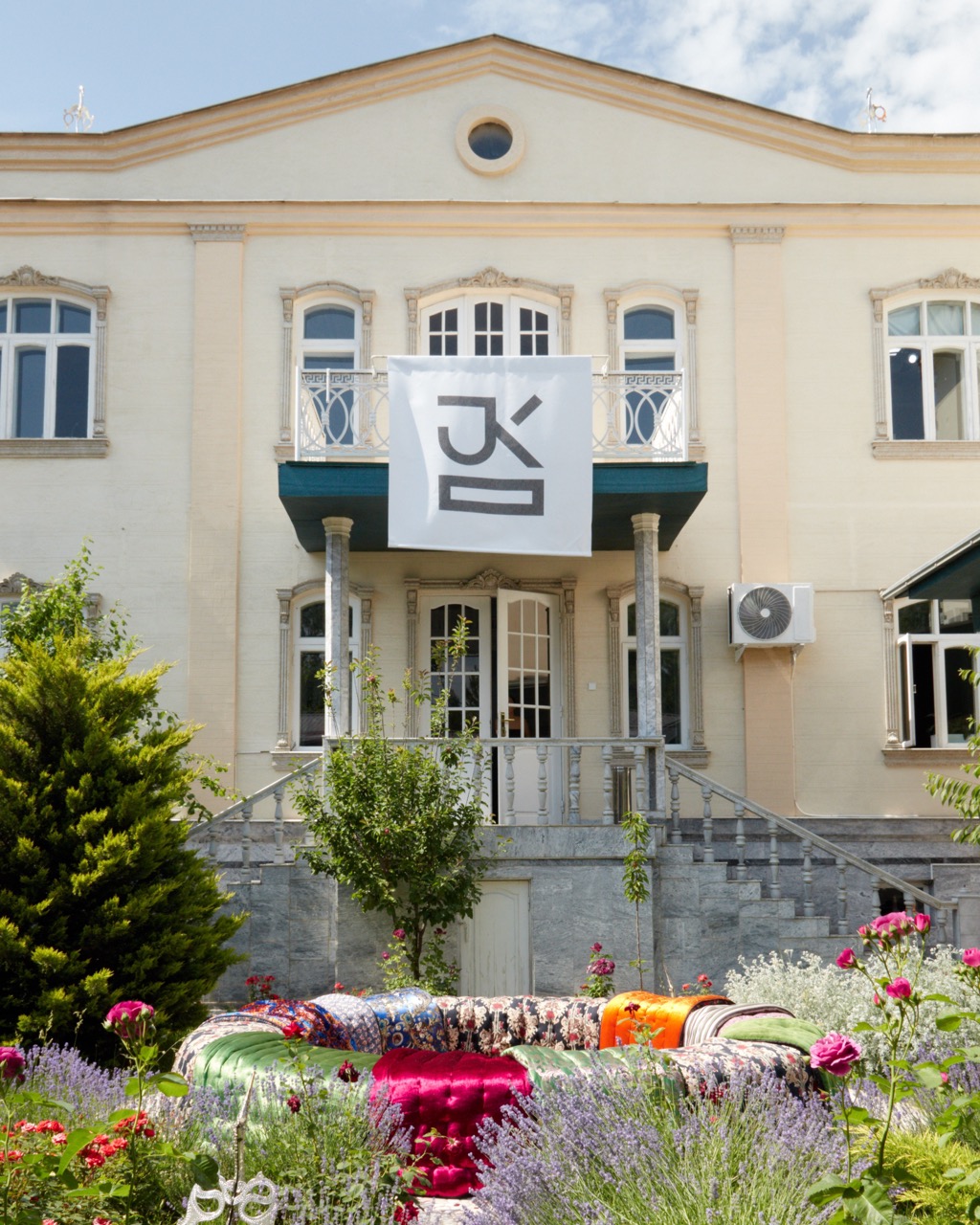
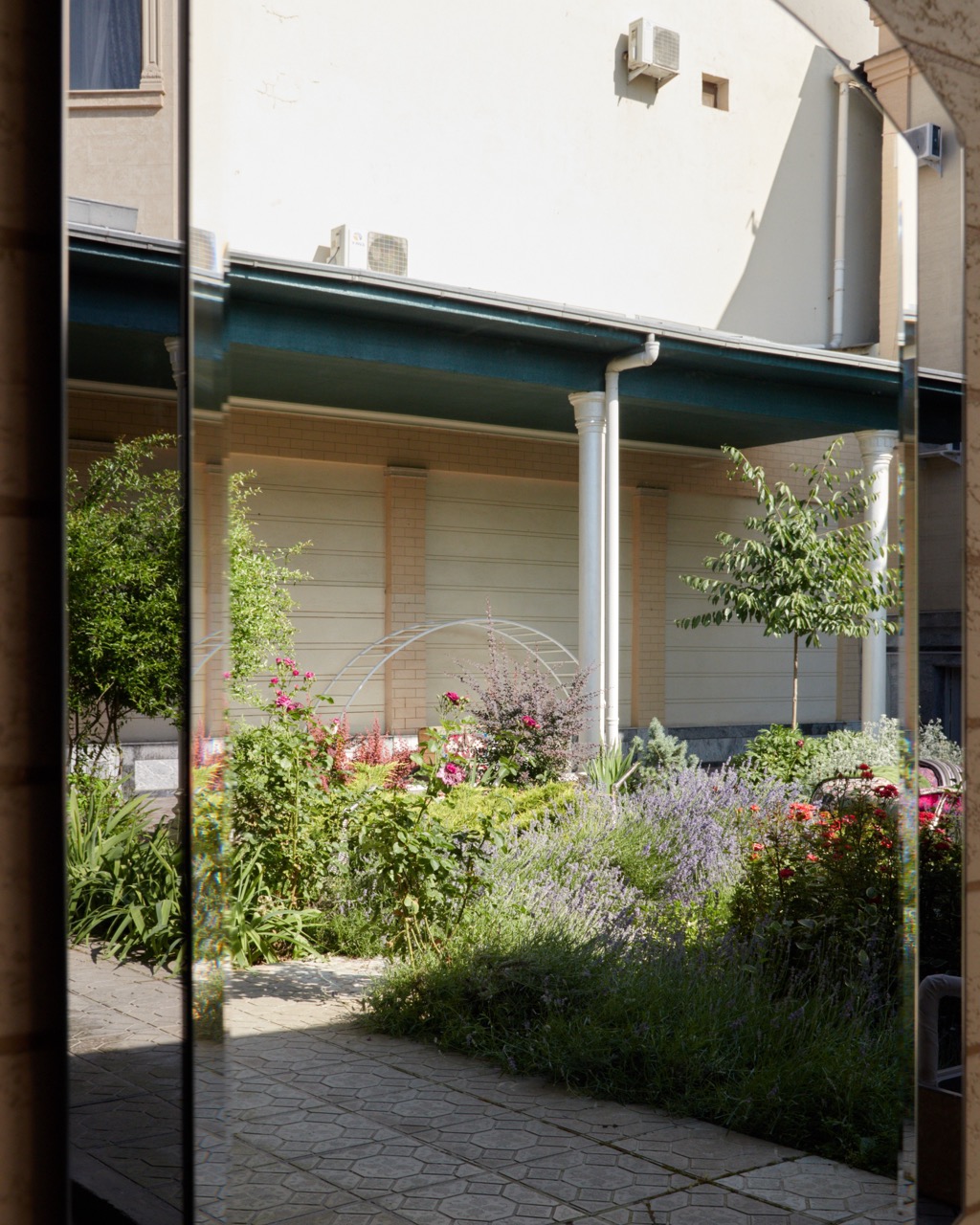
On a leafy street in Yunusabad, just north of central Tashkent, behind a wrought-iron gate and a garden planted with roses, irises and young fruit trees, stands a pale yellow villa that once belonged to a prosecutor in the municipal justice system. Today it houses the studio of designer Jenia Kim, whose eponymous label — founded in 2014, while she was living in Moscow — has become one of the defining voices in contemporary Central Asian fashion. While many designers from the region have built careers by leaving, Jenia has spent the last four years doing the opposite: building a company, a studio and, increasingly, a creative community in the city where she was born.
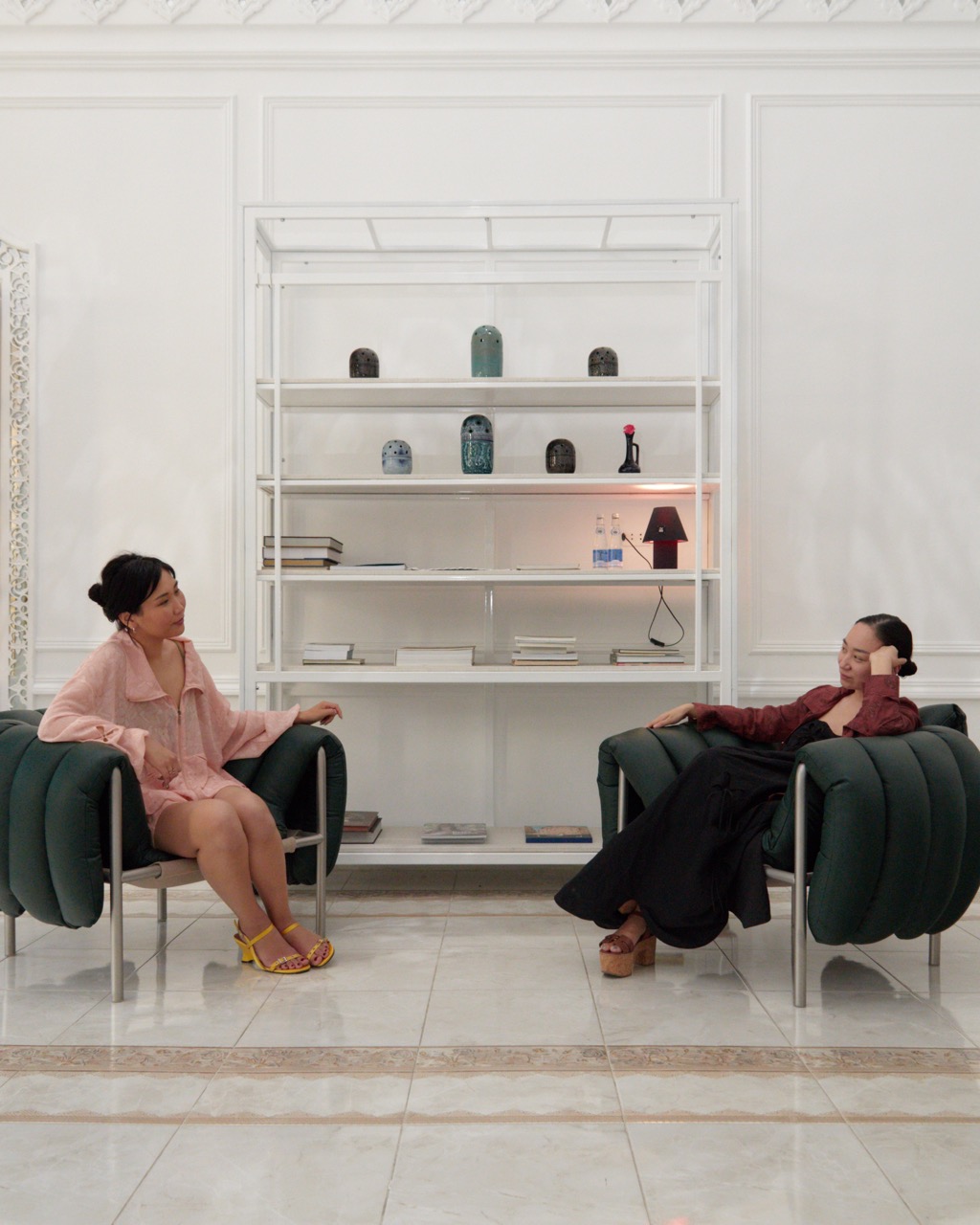
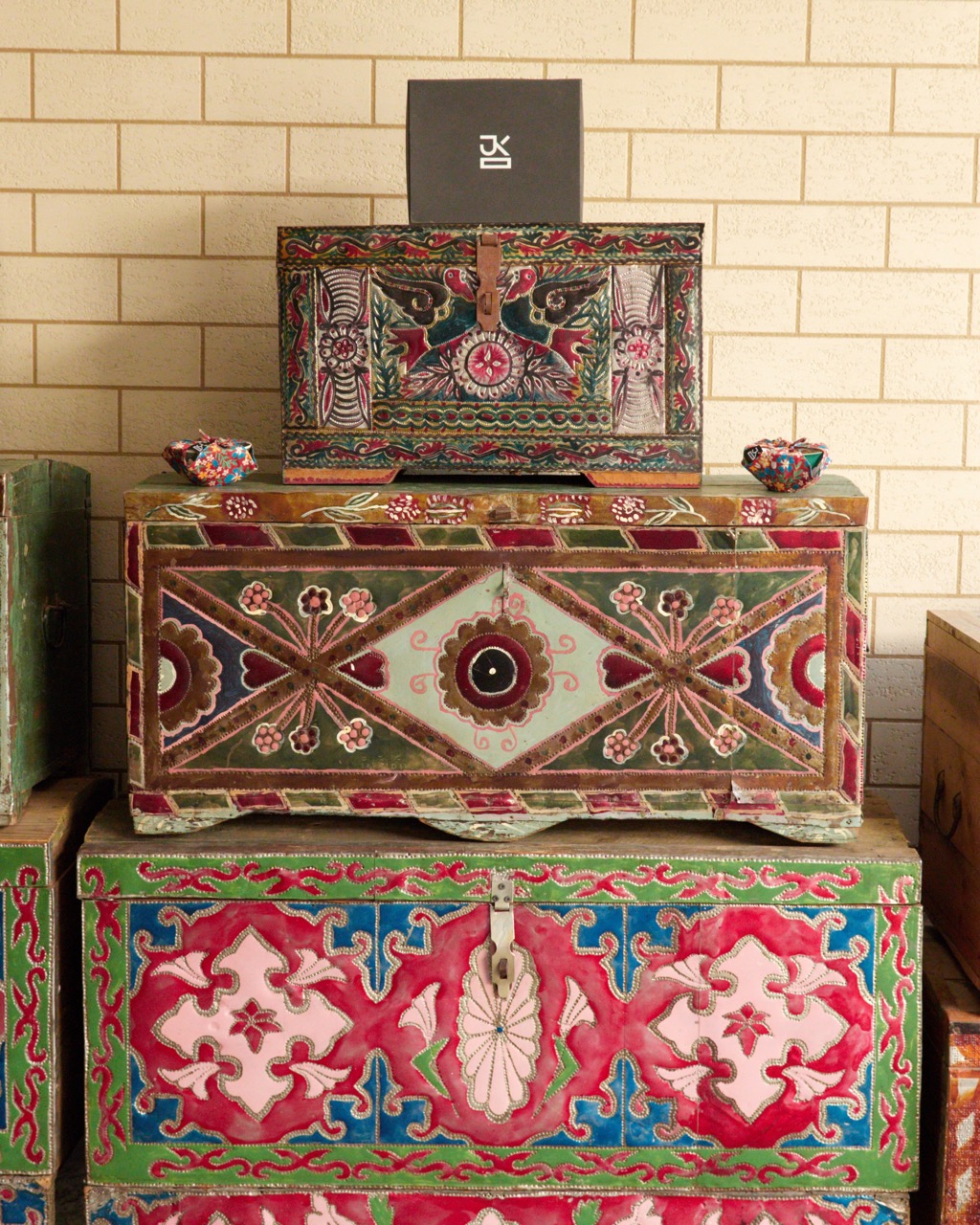
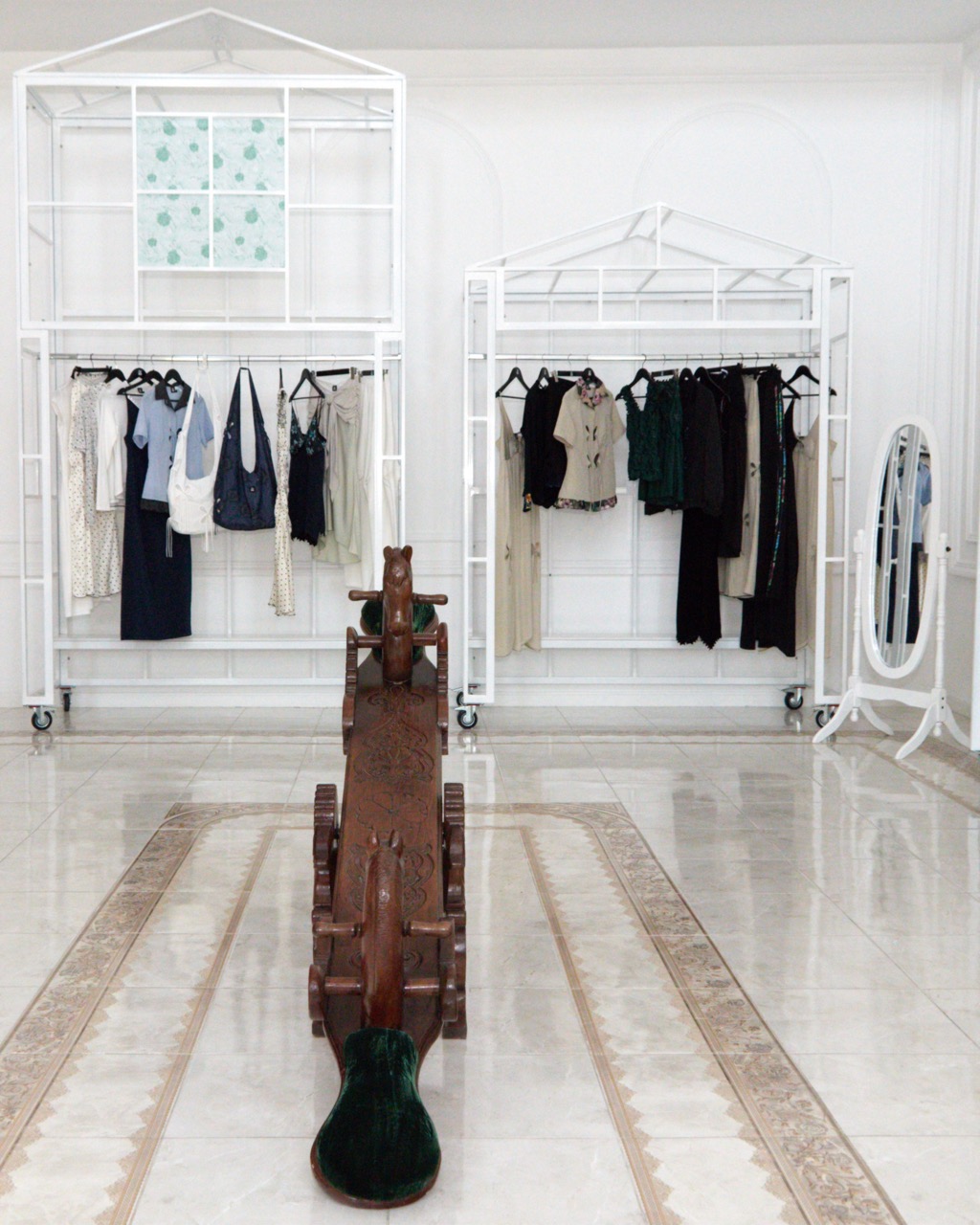
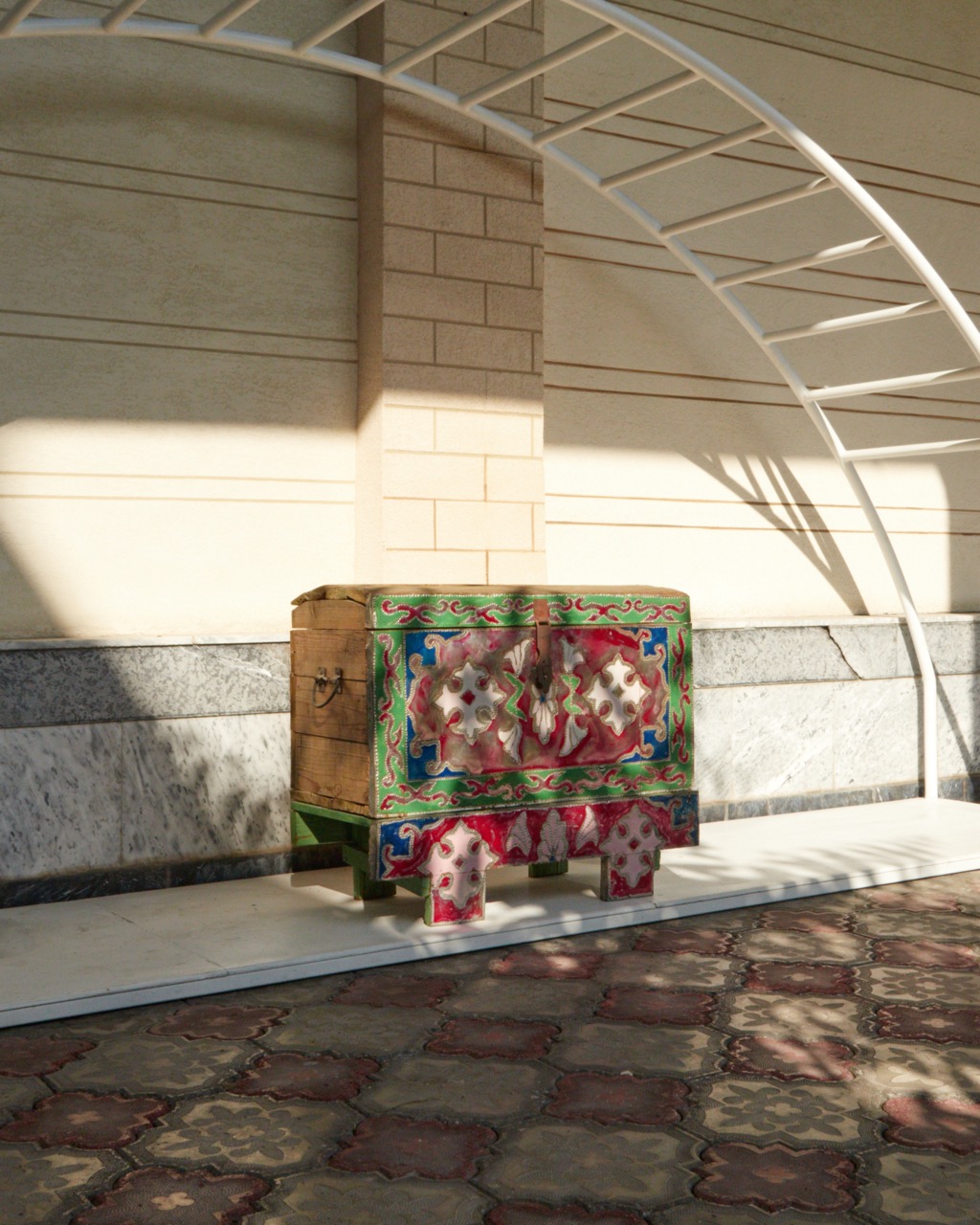
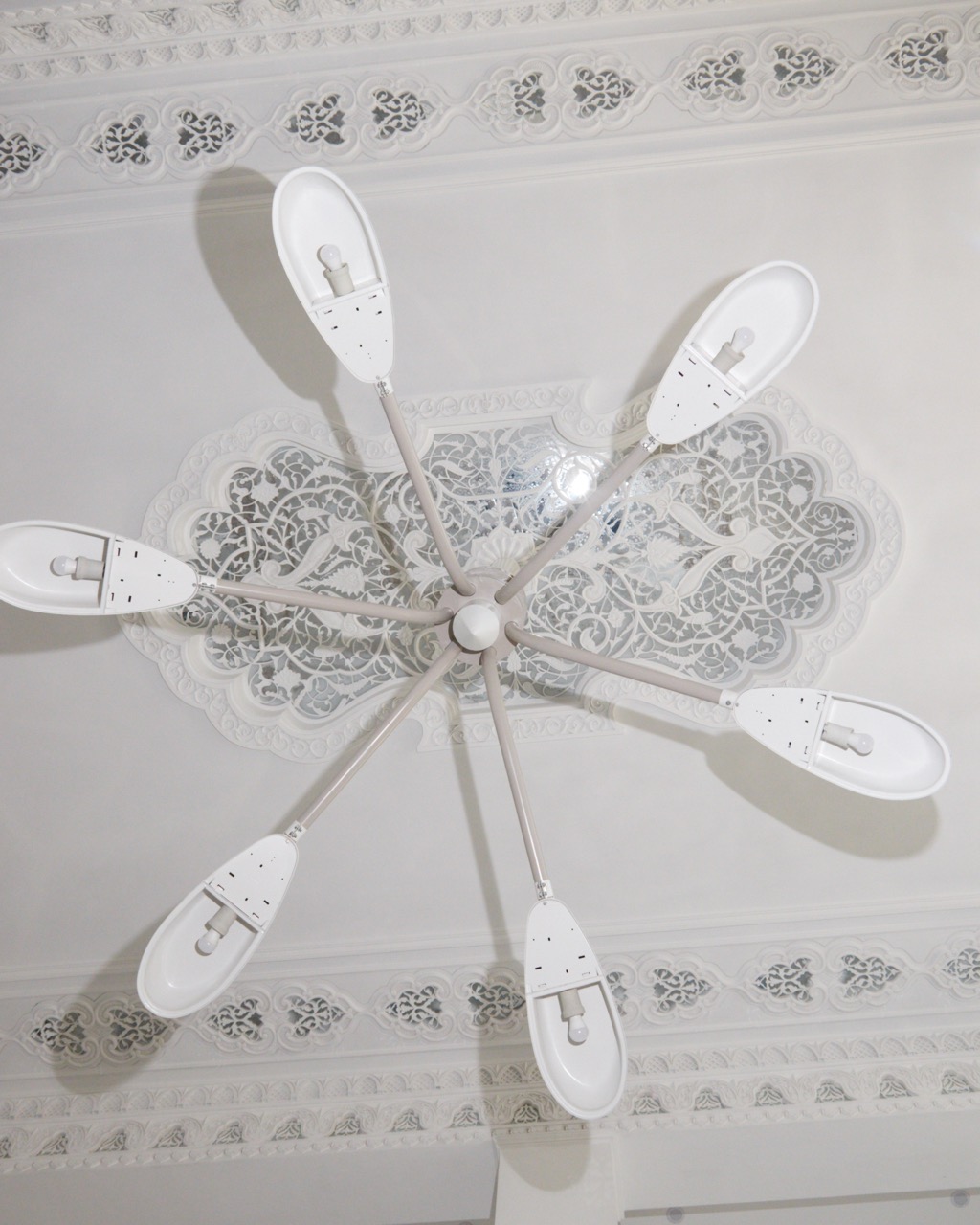
A gravel path winds through the garden. At its centre is a fountain, empty of water and instead piled with kurpacha — the thickly patterned cotton mattresses found across Uzbek homes. Under a columned portico sits a tapchan laid for tea, the traditional raised platform found in Uzbek courtyards and teahouses. Inside, a double-height hall opens beneath an ornate balcony, its original plasterwork still intact. At its centre sits a monumental carved wooden see-saw. Along the walls are antique Uzbek chests, sandiq, collected by Jenia over years of travelling across the country. Overhead hangs a chandelier she designed from discarded street lamps. ‘I was scared it would fall one day,’ she says, laughing. The first room on the left is her office. It is unexpectedly modest: a desk, a lamp she designed herself, a stack of sketches, a board pinned with fabric swatches and handwritten notes.



Hanging from a rail are pieces from the Spring Summer 2026 collection Quroq, presented in Almaty eight months earlier. What looks from across the room like a single printed fabric turns out to be remnants stitched together, no two quite matching, their seams left visible. Quroq textiles are traditionally made collectively, passed between women in a household as a way of using nothing new and wasting nothing old. An early exploration of the technique gave Jenia a dress built from the same diamond-patched canvases young women once spent months hand-making as part of their dowries. I don’t recognise the fabrics yet — that will come later in the week, on a market stall piled with the same faded florals and geometric prints, cut for kurpacha rather than dresses and jackets. Nor do I register the sequins scattered through some pieces, the same dense shine on garments worn by aunties I’ll later see on my travels to Samarkand. For now, everything looks beautiful and unfamiliar in a way I can’t quite place — close to the effect Jenia is after: taking Uzbek textiles she grew up around and putting them in front of people who have never had reason to look at them twice.
Photographer Hassan Kurbanbaev has known Jenia for almost a decade and worked with her repeatedly on J.Kim projects. ‘For us, it has never been simply a commercial shoot, or a relationship between a client and a photographer,’ he tells me. ‘Jenia, like me, is interested in stories that aren’t necessarily tied to commerce. I think there is always a message in them.’ Before shooting, they discuss each idea in detail, developing characters and thinking through how the story might unfold. ‘Jenia gives you freedom, but at the same time she remains involved at every stage of the project.’
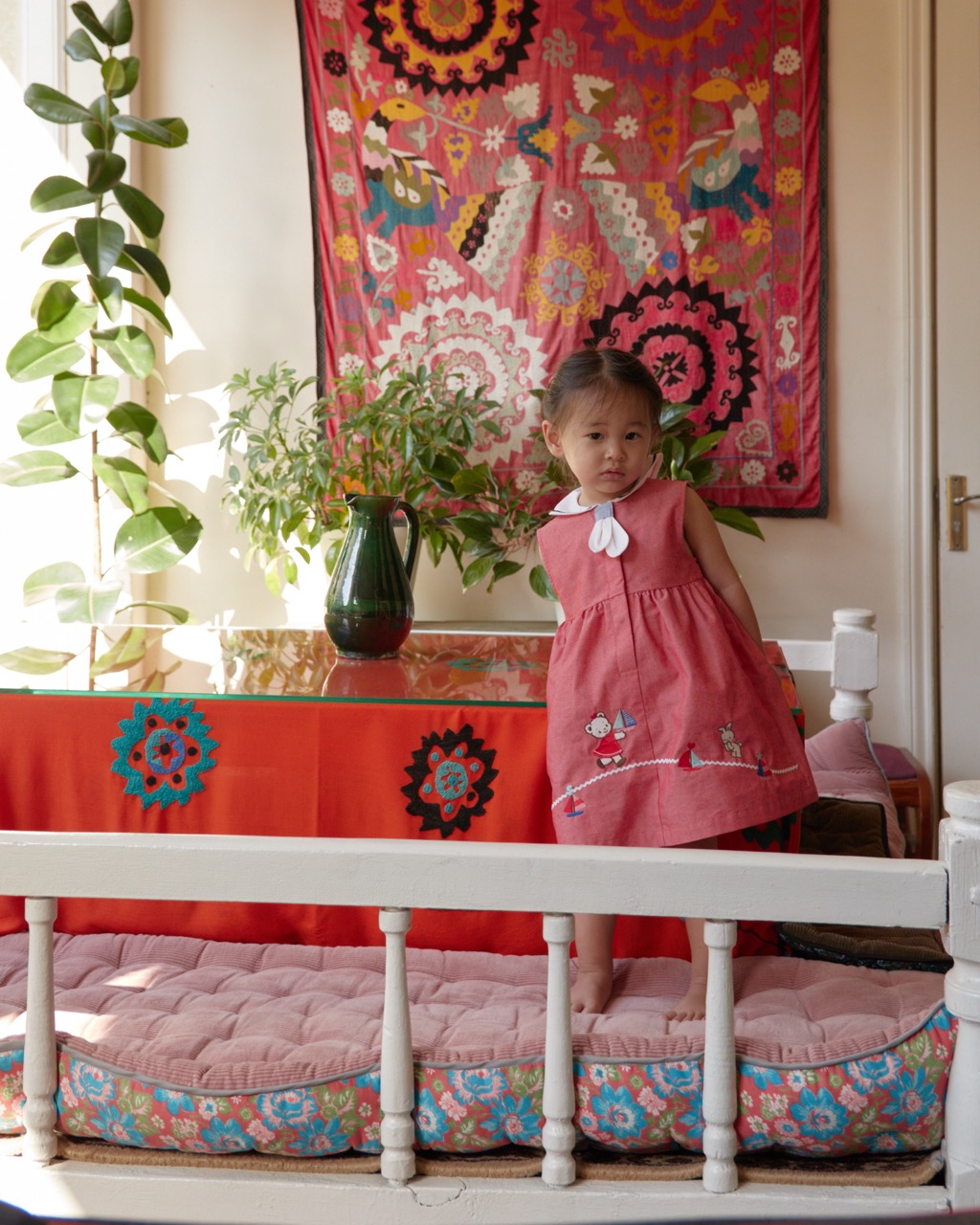
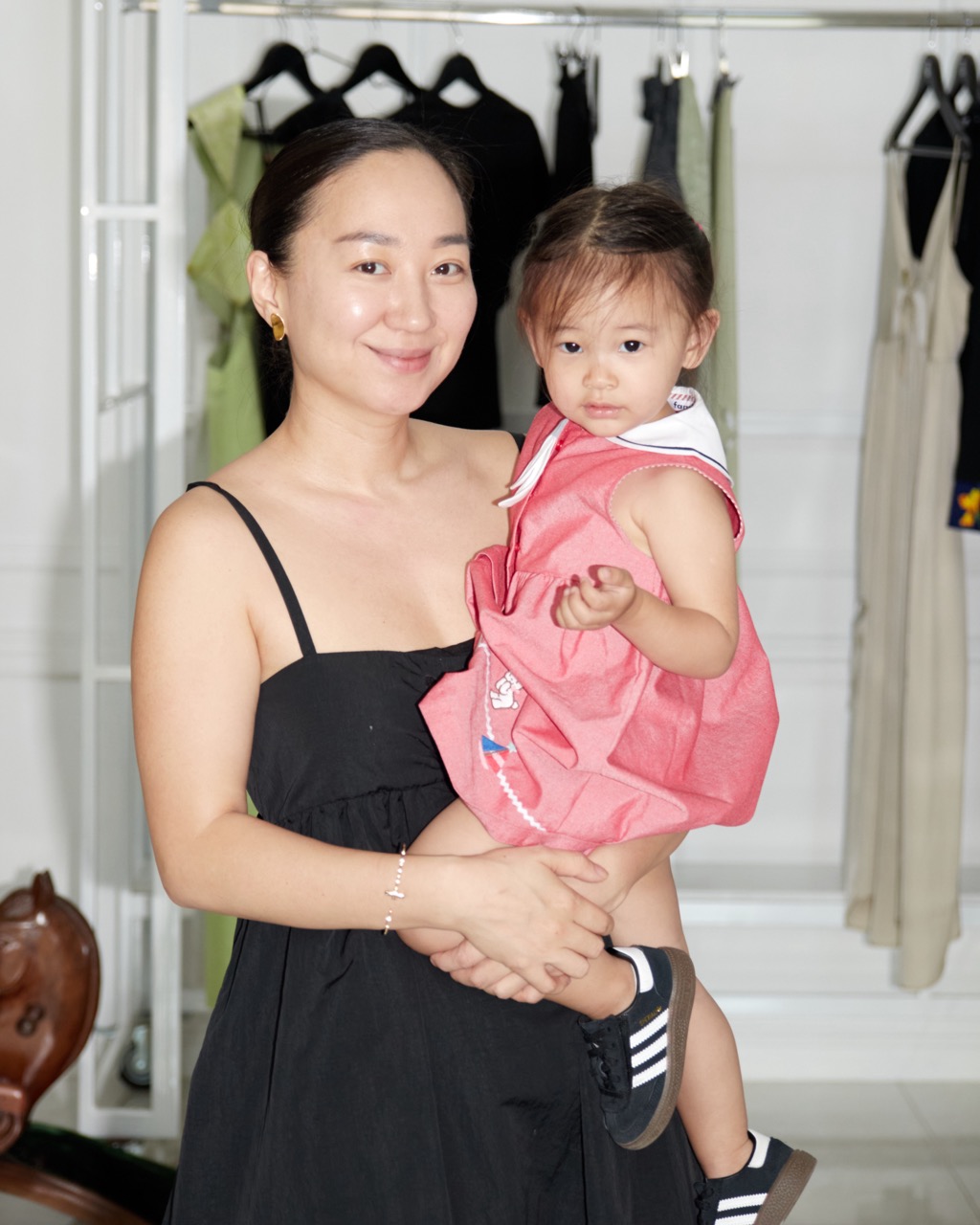
Over the few days I spend in Tashkent, I realise the J.Kim House resists simple definitions. It is a studio, certainly, but it is also where Jenia’s daughter wanders in and out of conversations, friends stop by and work unfolds at a pace that seems entirely its own. At one point, Russian pop music suddenly floods the atrium. Jenia laughs, scoops up her daughter and, still perched on towering wooden platforms, dances across the hall, spinning her in circles. A few people glance over and smile, unsurprised. When the song ends, she sets her daughter down and the conversation continues.
I first met Jenia several months earlier in Paris. There, I mistook her reserve for distance. She answered questions carefully, allowing silence to settle before speaking again, and seemed entirely uninterested in the rituals of self-presentation that fashion so often rewards. She never appeared uncomfortable, only unconcerned with filling the space. It is only in Tashkent that I begin to understand those pauses differently.
Born to a Koryo-saram family, descendants of the hundreds of thousands of ethnic Koreans forcibly deported from the Soviet Far East to Central Asia under Stalin in 1937, Jenia was 11 when her family moved to Moscow from Tashkent. It was there, she tells me, that she first became conscious of her appearance as something that determined how the world might read her before she had spoken a word.
‘I wanted to be Russkaya,’ she says, using the Russian word that refers not simply to a citizen of Russia but to someone who is ethnically Russian — and therefore white. As a teenager, she was convinced that no one would ever marry her because she was Korean. She laughs softly when she says it now, almost incredulous that she once accepted the thought so unquestioningly.
In her early twenties, she moved almost exclusively within Asian communities in Moscow: Koreans, Buryats, Kazakhs, Kalmyks. For the first time, she had something like community, people who didn’t require explanation. But there, too, she found herself being read collectively rather than individually. Later, as she began building a career in fashion, the rooms she needed to be in changed. Moscow’s creative and fashion circles were — and still are — overwhelmingly white. There, a different kind of comfort emerged: being the only Asian person in the room. There was no group to disappear into. She could simply become Jenia.
One memory has stayed with her. More than ten years ago, friends from Kazakhstan came to visit Moscow and together they went to one of the city’s fashionable nightclubs. As they approached the entrance, she instinctively walked several steps ahead, hoping people would assume she had arrived alone. ‘I didn’t want people to think I was with them,’ she tells me matter-of-factly. She doesn’t lower her voice or soften the confession. ‘It wasn’t about them. It was about me.’
The memory became something to investigate. She began reading about the history of the Koryo-saram community and the forced deportations that had brought Soviet Koreans to Central Asia, then moved into Korean history, Uzbek history and the ways identity survives through ritual, language, family stories and objects. Looking back, she sees her early collections, designed between 2013 and 2018, less as expressions of identity than as documents of that inquiry. She wasn’t trying to tell the world who she was. She was trying to find out.
‘For us, it has never been simply a commercial shoot, or a relationship between a client and a photographer. Jenia, like me, is interested in stories that aren’t necessarily tied to commerce. I think there is always a message in them.’
Hassan Kurbanbaev




By her early thirties, the urgency had begun to fade. ‘I healed,’ she tells me simply. The insecurities that had once fuelled her ambition gradually loosened their hold. ‘Fear was a huge motivation for me,’ she says. ‘Now it isn’t.’ The change left an unexpected space. If understanding herself was no longer enough to propel her forward, what was she building for? Jenia speaks about the fashion industry with an unusual degree of scepticism, particularly its dependence on aspiration and insecurity. ‘I think it’s often about safety,’ she tells me. ‘People buy things because they want to feel safe.’ The expensive bag makes us more confident walking into a hotel lobby; the right clothes promise belonging at a party. Fashion has become remarkably effective at selling reassurance. ‘I want people to respond from their inner self,’ she says. ‘Not from complexes shaped by the outside world.’
She knows it is an idealistic — and commercially difficult — ambition. Brands built around status and desire often grow faster than those asking consumers to buy more consciously. ‘Maybe that’s why we’re developing so slowly,’ she says with a smile. For Jenia, the question has gradually become less about how many people buy into the brand than about what kind of values it can sustain — and what it can do for the place it comes from.
Today, she estimates that design occupies only a fraction of her working life. Much of her time is spent overseeing production, managing finances, mentoring employees and building a company capable of existing beyond her own creative output. ‘I don’t want everything to depend on me,’ she says. ‘The goal is to build something that can continue without me.’
I see what she means one afternoon over lunch, when Blake — the editor-in-chief of A Magazine, who has travelled with me to Uzbekistan and is meeting Jenia for the first time — joins us at the house. Jenia orders plov from a nearby café: two traditional portions for us, a vegetarian one for Blake and a big plate of pickles to share. We eat on the tapchan while the studio carries on around us. Halfway through the meal, three customers wander into the garden. Blake and I pause. ‘Do you need to go?’ we ask. Jenia looks over briefly before shaking her head. ‘It’s better if I don’t. My team is much better with clients than I am.’ One of her colleagues walks over to greet them while Jenia tears off another piece of bread and carries on eating. The instinct that once compelled her to examine her inner world has turned outwards. She speaks less now about self-expression than about creating structures that make it possible for others to stay, work and imagine a future where they already are.


‘Jenia and the J.Kim team are a great example of how you can build a brand locally but develop globally. I think that inspires young creatives here to trust their own ideas more. There are people who tell stories, and there are people who create them. Jenia is one of those people. She cares. I care. The people around us care.’
Kami Akhmed
The moment she recognised that shift had nothing to do with fashion. In February 2022, after Russia invaded Ukraine, anti-war demonstrations broke out across the country. Within hours, riot police were moving through the crowds, and by the end of the first day more than 1600 people had been detained across Russia. Some of the harshest crackdowns were documented at Pushkin Square. It was towards that same square that Jenia found herself walking to join the protest. ‘I realised I felt responsible,’ she tells me.
For much of her life, belonging had meant searching for acceptance. Now it meant accepting responsibility for the place where she lived. Jenia’s return to Tashkent had, in fact, begun several years earlier. From 2018 to 2022, she divided her time between Moscow and Tashkent: the design side of J.Kim was increasingly based in Uzbekistan, while much of the business development and communications still happened in Russia. After the invasion, that arrangement ended. Since 2022, she has lived in Tashkent full-time.
Many creatives left Moscow after the invasion, some out of principle, some because staying no longer felt safe or possible. Jenia had options too. Instead, she chose to consolidate what she had already begun building in her hometown. The decision wasn’t driven by nostalgia. Building a fashion business in Uzbekistan meant working in an ecosystem that barely existed: few manufacturers capable of producing the quality she wanted, few experienced specialists to hire and little of the infrastructure designers elsewhere take for granted.‘But if I leave,’ she says, ‘nothing changes.’ She pauses. ‘And if people stay, if enough people decide to build something here, then maybe the next generation won’t have to make the choice between staying and leaving at all.’
What she is building in Tashkent isn’t only a fashion label. Jenia speaks as readily about photographers, stylists, artists and directors as she does about designers. She imagines creative communities rather than individual careers, ecosystems rather than isolated success stories. One of her long-term ambitions is to establish an incubator, residency or competition for emerging Uzbek designers, developed with experts from around the world. She wants to give them the less visible knowledge required to turn clothes into viable businesses: brand building and product development, but also technical documentation, pricing, production and cost planning. She has already pitched the idea to a major foundation. Whether it happens remains uncertain.
Stylist Kami Akhmed has already experienced that support. When she was launching 7/1, a public talks project inviting figures from art and fashion to share their knowledge with aspiring young creatives in Tashkent, Jenia agreed to be its first speaker. ‘She supported what I was trying to do, gave me opportunities to express myself creatively and, perhaps without even knowing it, inspired me to attempt something bigger,’ Kami tells me. ‘To create within the culture that raised you, and to treat what you do with respect.’ For Kami, J.Kim is proof that staying does not necessarily mean thinking smaller. ‘There are people who tell stories, and there are people who create them. Jenia is one of those people,’ she says. ‘She cares. I care. The people around us care.’
Jenia often thinks about the decisions her own family had to make. Her parents did not leave Uzbekistan because they wanted to abandon it. Like so many families across the former Soviet Union, they moved because opportunity existed in Russia: better education, better work, better prospects for their children. She hopes her daughter will grow up with a different kind of freedom — not simply the freedom to leave, but the freedom to choose. To inherit a country where staying does not require sacrificing ambition.
On my first evening in Tashkent, Jenia suggests dinner. We are joined by Dasha, her operations director, who moved to Uzbekistan from Saint Petersburg after the war began, having never before set foot in the country. The conversation wanders between work, Moscow versus Saint Petersburg and how differently people our age drink now compared to a few years ago. Dasha says she rarely drinks anymore. Jenia nods; she hasn’t touched alcohol in months. ‘It changed my life,’ she says. Then, smiling: ‘But sometimes… sometimes it would feel so good to just get completely wasted.’She uses the Russian word nabukhatsya, so gloriously unrefined after an evening of careful conversation that all three of us burst out laughing.
Jenia leaves before us, wanting to get back to her daughter. Dasha and I linger over the last glasses. Before joining J.Kim, she was a lawyer in Saint Petersburg. When Russia invaded Ukraine, she knew she had to leave, applied for the role on Instagram and moved to a country she’d never visited. When I ask how her family reacted, she laughs. ‘They still don’t understand why I moved here. I think they are ashamed of my decision.’ The sentence exposes a hierarchy that continues to shape the post-Soviet imagination: for many Russians, Central Asia remains somewhere people leave, not somewhere they deliberately choose.
The first months were difficult. Dasha arrived as a young blonde Russian woman whose instinct was to smile, chat and make herself immediately familiar. Tashkent demanded a different rhythm. Relationships took longer to build. Trust was earned more slowly. Rather than expecting the city to accommodate her, she learnt to accommodate herself to it. ‘I am a foreigner here,’ she says simply.
When I ask what it is like to work with Jenia, the answer comes immediately. ‘She’s very straightforward, and she knows exactly what she wants.’ She tells me about opening J.Kim Objects, the brand’s concept store for homeware and vintage finds, inside Chorsu Bazaar, Tashkent’s sprawling, centuries-old covered market. The idea made little practical sense to anyone else on the team. Jenia insisted. ‘My instinct is always to move on once something is good enough,’ Dasha says. ‘Jenia pushes us to keep going until it’s perfect. And I’m happy to be led by someone like her.’
It’s the same certainty, I realise, off the clock. In Paris, I’d taken Jenia’s silences for reserve. In Tashkent, I understood: she wasn’t being careful with me, she simply had nothing left to perform.
Photography by Abdulaziz Yuldoshev (transoxian)