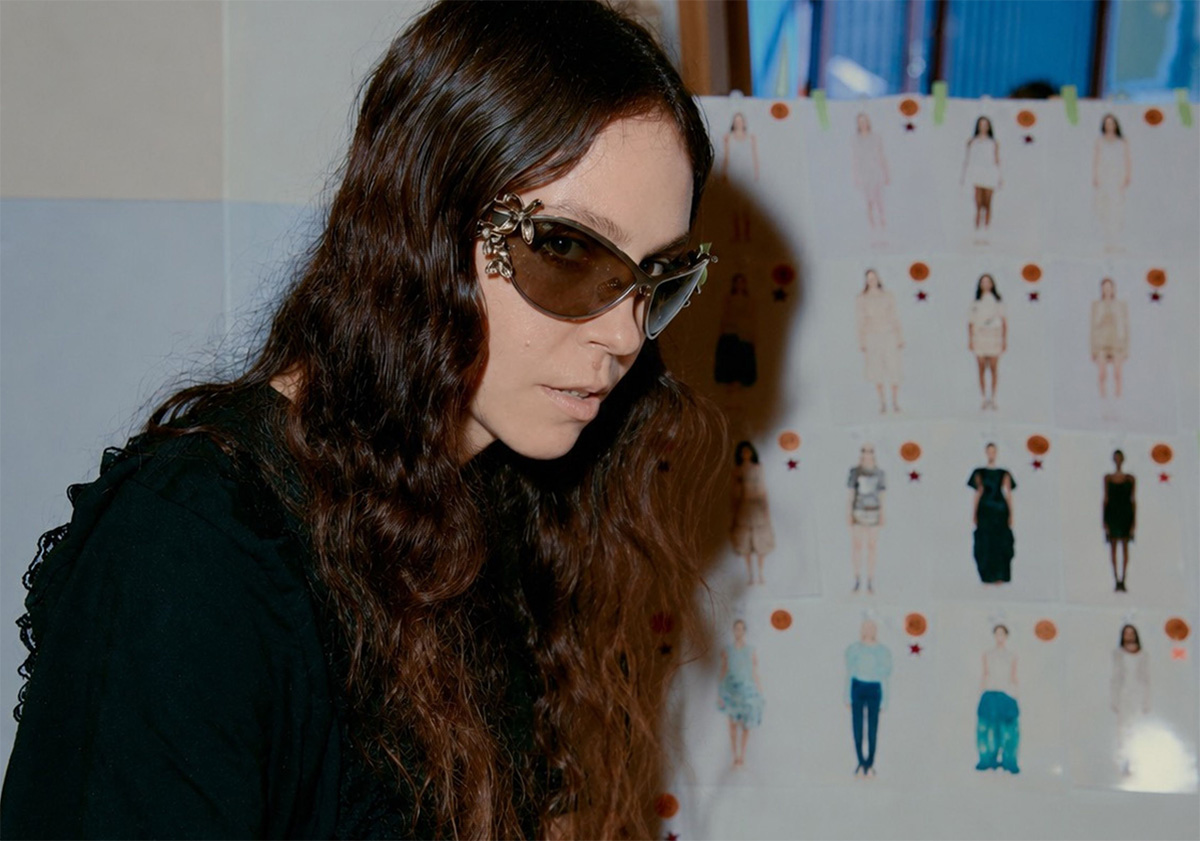
MB: You already knew you were doing the show in the church? That must have been planned for a long time, right?
WC: I really wanted to do the show in a church because I wanted to fill the church with people who are marginalised and under attack right now. I thought putting them in the church and giving them this beautiful space, showing that they’re welcomed was a lovely way to show the collection.
It was days before the show, and we were crazy. It was during that time that people started texting me: ‘Oh my gosh — did you see the Bishop’s speech? Did you see the inauguration?’ I hadn’t. Of course I hadn’t. So the night before the show, at about 11 pm, I pulled it up on my computer while we were working. Everyone in the studio gathered round. It was just everyone with their hands over their mouths — in awe, in tears — listening to your speech. That’s when I said, ‘Okay, we have to put this in the show. That’s all there is to it.’ It was just this amazing convergence. So beautiful. I’m really honoured that I can use my platform to touch people in a way they normally don’t get tapped into. It was a privilege to share that speech in such a beautiful and personal way with the audience.
MB: I’m so honoured that you did that, and I especially love the fact that you chose, beforehand, a church that is often not perceived as a place of welcome for so many people, though we try to be. Our church really tries to communicate that welcome, but there’s a lot of history, a lot of perception and obviously mixed messages that come from Christianity, as you well know. So for you to have done that, and then to have used that portion of my address — really, thank you. How was it experienced in the room? Were you pleased with the entire show? Was the show what you hoped it would be?
WC: Oh yes. I was over the moon. It was our first show in Paris, which was amazing. And, you know, anytime you do something that is slightly political, it’s a high risk. I was very pleased with the way people ingested your message and the message of the show. The beauty of it all. It was very powerful. And I thank you for that.
MB: Well, you’re very welcome. My colleague, the bishop in Paris, has oversight of all our churches in Europe; he didn’t know about the inauguration thing at all. He was there, and he wrote to me afterwards. He said to me: ‘Then I just heard your voice, we just heard it.’ He was like: ‘I can’t believe it. I heard you! That was the first I had heard it.’ As you can imagine, just like you were saying, it’s not uncommon for me to engage in speech or actions that are perceived as political. I don’t often have an opportunity like that — almost never, actually — to say something directly to a president. So, you can imagine the reaction was similar. There was a lot of energy in those first few days, but I have to say, hearing about your show was a highlight.
WC: That’s amazing. Yes, I met the bishop in Paris after the show, and I cannot believe that was the first time he heard your speech.
MB: He wrote to me right afterwards and said, ‘I’m in the cathedral at this amazing show, and I hear your voice.’ I didn’t have any understanding that that service and address would go any farther than the moment itself, in the cathedral. The perception now is that the service was a huge media event, but it actually was rather small. We live-streamed it in our cathedral, but all the major inauguration events — the speeches, the performances — happened the day before. This wasn’t exactly an afterthought, but it wasn’t big news anymore. All the attention came afterwards; I think it was social media, and people commenting and sharing. And then, of course, the president had not very kind things to say — which set off a whole other round of responses.
WC: Was there any further — I mean, you don’t have to answer this — but was there any further action taken by the president after?
MB: No. He has bigger fish to fry, right? He’s been pretty busy. But he simply said something after the service that wasn’t complimentary, rather muted. But that night, as he sometimes does, he went on social media and suggested that I ought to apologise to him and to the American people. As often happens, that communication sparked a big wave of responses. But then there was this other wave of such overwhelming support and gratitude. Often it came from people who would start by saying, ‘I’m not a religious person’ or ‘I left the church years ago’ or ‘I’m an atheist… but I want you to know…’ Those kinds of messages really meant a lot to me.
WC: Well, I also thought it was so important and poignant, because as you mentioned earlier in our conversation, there are so many mixed messages about Christianity right now — so many distortions of what Christianity is. I’m sure it’s been this way throughout history, of course, but it further confirms for me that my understanding of scripture is beyond the words that are written. I see how things are misinterpreted. What is considered ‘Christian nationalist’ or ‘Christian’ in this country is very easily misunderstood. So many people associate it with destruction, with war, with hate. I think it’s beautiful to remind people that that isn’t what it really is. At its core, it’s pure love. And that’s all.
MB: You’re right — what we’re seeing is nothing new. But it’s a particular form now, aligned with a lot of political power. So it’s a worry. All the more reason to quietly — at least I feel it’s not self-serving — fight back, right? Because then you just take on the tools of violence to counter what is violent. Instead, we try to model the clarity and conviction of Jesus himself and of the biblical prophets; they were clear but not aggressive, violent or hateful. That’s the challenge or call — for those of us trying to embody something of that message. And to honour the dignity of every human being, which also seems to be a big part of your work. To call forth the elements of your background and of people who wouldn’t necessarily associate their lives with high fashion and to say: ‘You belong here too. There’s no place where you don’t belong.’ Which is a lovely message.